Friday, October 26, 2012

Traveling "Going-to-the-Sun Road" Part 2 Sunrift Gorge to Logan Pass

Jackson Moutain, the glacier on the left side of the snowy peak and is not showing.
Sunrift Gorge was fun to explore but it was time to get in the car and travel to Jackson Glacier scenic turnout.  All the glaciers in the park will be gone by 2020 due to the environmental warming trends.  The park will still be beautiful but the glaciers are a very important geological and environmental force that shaped this national park.  If you want to see glaciers make plans to spend your vacation in this park next year.
Jackson Glacier
Siyeh Bend was fun watching the cars and the park's famous Red Buses driving to and from Logan Pass.  If you do not want to drive on a narrow twisting road taking a Red Bus tour would be a fun way to see the park.  I believe the Red Bus Tours only stops at Logan Pass, the park's does have free shuttle service with many stops along the road where you can get off and explore before continuing on your journey.  
One of the famous Red Bus passing through Siyeh Bend.
Looking up from the Siyeh Bend
you can see Cataract Mountain.


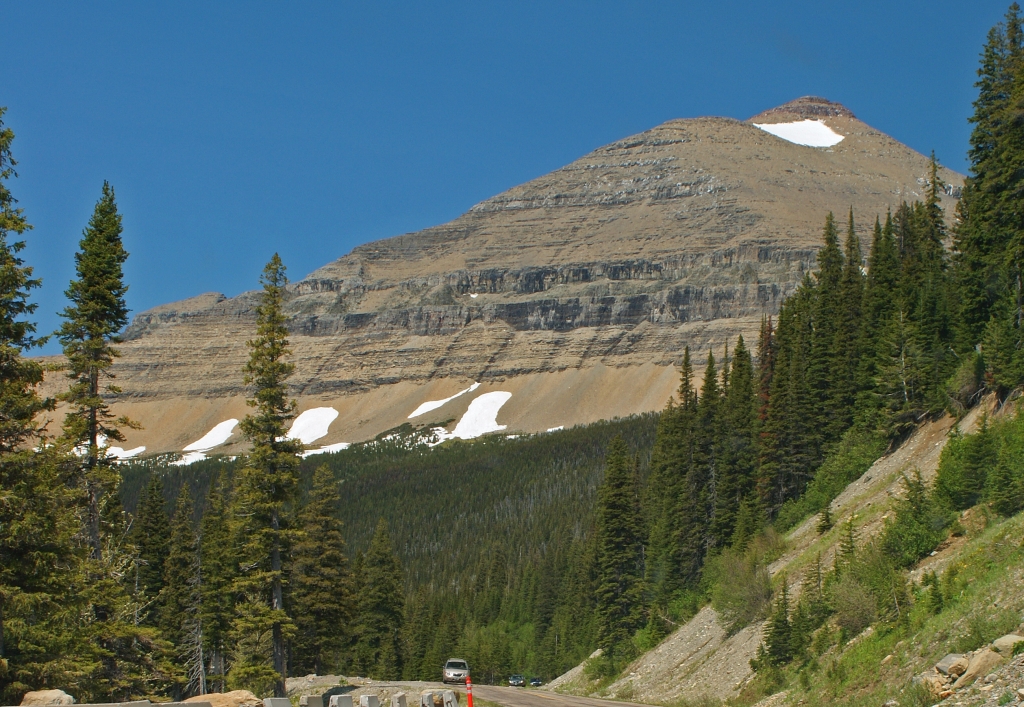
A view of Siyeh Mountain before the bend.

 The June 19th was the first day you could drive from through from the west or the east to the other side.  The road was only open for 16 days before I made the trip and there was still snow along the road near the bend.  The latest the road has opened was July 13, 2011 due to several late winter and early spring storms.
Leaving Siyeh Bend and heading toward Logan Pass.

This picture was taken from an outlook at the top of Siyeh Bend, you can see it in the picture above.
The mountain left of center is Reynolds Mountain and Clements Mountain picture on the upper right edge.
East Tunnel
I made two more stops between Siyeh Bend and Logan Pass.  The mountains just loomed above the road and there is a tunnel going under Piegan Mountain.  Just before I reached Logan Pass I passed through an area called the Big Drift.  The snow falls along the pass can cause drifts to be 90 feet deep along here. The drifts were approximately 20 feet deep for me to see.    Unfortunately there was nowhere to stop and take pictures.  Since I was traveling alone, there was no way I was going to try drive and take pictures on this narrow twisty road.  If you are interest on how the park clears the snow you can find it on the Glacier Park Web site.


This shot was taken at the same outlook as the east
tunnel picture.  Reynolds Mountain looms
above the scenic valley.

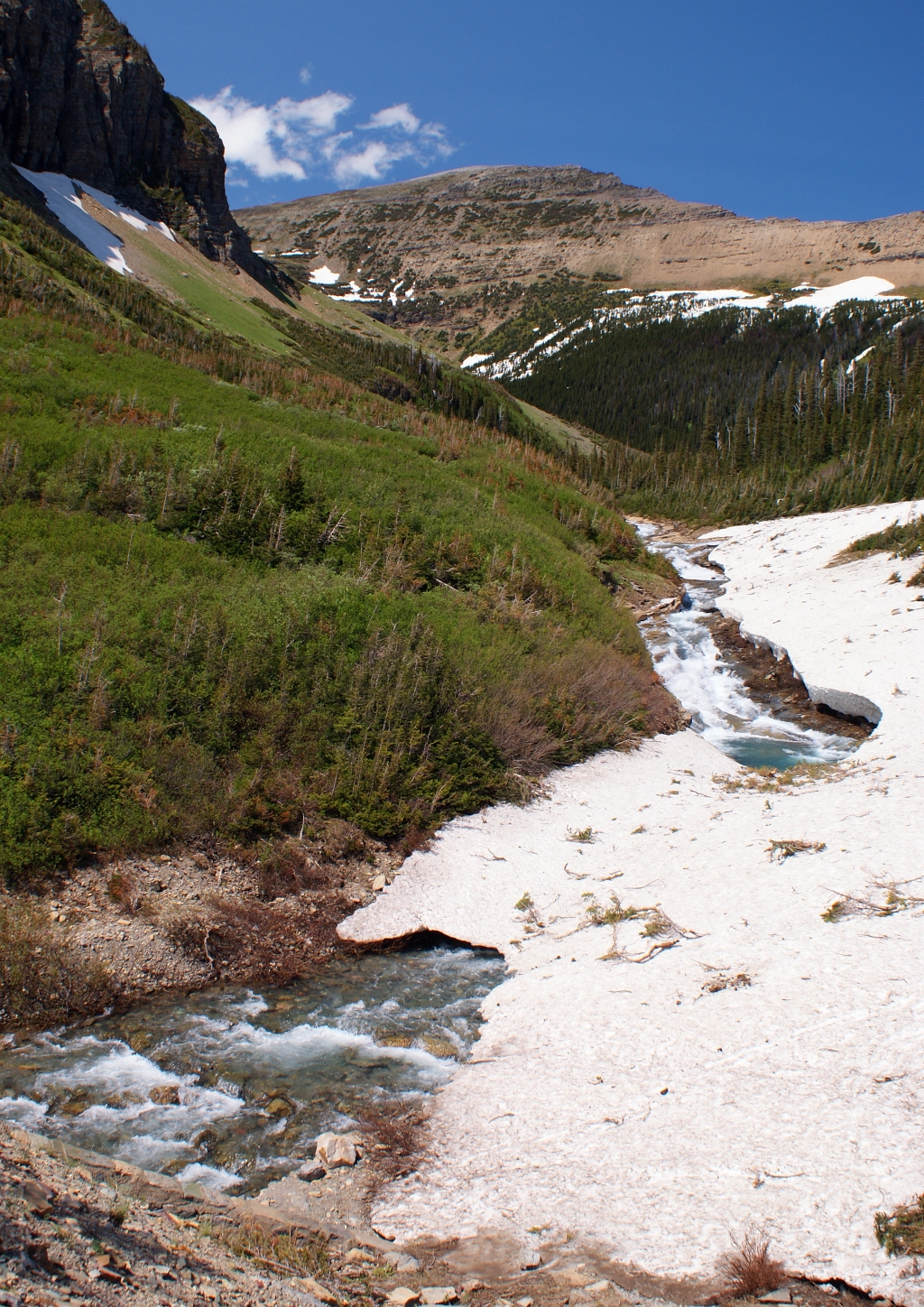
A closeup of the falls at the bottom
of the picture on the left.


Logan Pass was completely covered under snow except where the park dug out the parking lot and walkway around the Visitors Center.  The Visitors Center has a nice display about an alpine ecosystem.  The center does not have food available here but there were signs asking people to makes sure they did not leave food items they bring in the parking lot.  The food waste has been attracting the bighorn sheep and making them aggressive.  I did not see any wildlife in the park but I was driving midday and animals are most active early morning and late evening. 
Clements Mountain from the Logan Pass.  The black dots are people hiking to Hidden Lake Lookout.
Both Hidden Lake and Highline Trails were covered with snow.  Only Hidden Lake Trail was open but it was very slippery.  I did try to take some pictures at the beginning of the trail but without a pair of ice cleats I decided to forgo the trip.  Take a close look at Clements Mountain picture and you see tiny black dots.  Those dots are people hiking to the overlook.
Reynolds Mountain, Logan Pass
Logan Pass is the highest point on the "Going-to-the Sun Road".  It is recommended to reach the Pass before noon since the lot fills up quickly.  I was lucky there were a few places open to park when I reach it.  There are times when the park service ropes off the parking lot so the earlier you reach Logan Pass the better your change to Glacier's mountains and alpine ecosystem.
Facing east on the pass you can see Going-to-the-Sun Mountain on the left edge.
Heavy Runner Mountain is on he right edge.
I leave Logan Pass still traveling west and the elevation keeps dropping down to Lake McDonald but this is for the next post.

Monday, October 22, 2012

Traveling "Going-to-the-Sun Road" Part 1


Singleshot Mountain hovering over Two Dog Flats
 After leaving the Visitor Center I stop to take pictures of Two Dog Flats.  The fields later in the summer are filled with prairie wild flowers. 
Indian Blanket (Gaillardia) in Rising Sun Parking Lot
It was now near 1 PM and I need to stop at Rising Sun to eat lunch. I was hoping to find a place protected from the wind and make my own lunch. The cool weather and wind changed my mind and I dined at Two Dog Flats Grill. The food was good but pricey and I have a great view of St Mary Lake. When you dine inside a national park I guess you should expect to pay extra for the ambiance and limited seating.  Lastly I checked out the gift shop and found some great old fashion postcards.

This looms over Rising Sun Motel.  Can anyone tell me if this is Goat Mountain?
Rising Sun is where the mountains begin and you keep climbing up in elevation until you reach Logan Pass. Once I left Rising Sun I spent my time stopping at each pullout and exploring it.  The guild books state it should take 2 hours to drive the road but do not believe it unless you plan to drive straight through.  I spend 6 hours driving it and I did not stop to walk any of the trails leading to the back country.  All my time was spent stopping at each turnout and maybe walking a few 100 yards off the road.  I joked that driving time is dependent on how many pictures you take at the end of the day I took 230.  I also needed to keep moving since I was expected to be in Alaska in 7 to 10 days from the start of the trip.
 
Wild Goose Island Lookout, see Notes for mountains names.
 The Golden Staircase and Wild Goose Island are the next two stops I took pictures of St Mary Lake at each.  Wild Goose Island is the most photographed stop on the road and the picture states it all.

Indian Paint Flowers

Alberta Penstemon
 Here are some of the flower you can see along the way.


Indian Paint and Alberta Penstemon Flowers
I must of skip Sun Point the parking area must have been full when I pass so I continue on to Sunrift Gorge.  Baring Creek formed Sunrift Gorge. 

 
Baring Creek falls

Next falls upstream from previous picture.


Sunrift Gorge

Baring Creek downstream from the gorge and falls.

Sunrift Gorge is about halfway to Logan Pass and the next post will be from Sunrift Gorge to Logan Pass.
Notes: It was easier to label the mountain than explain it in a cation.  Sorry I made 3 change on the mountain identification I keep find more information.  The last change came from Glacier National Park Facebook site.


Sunday, October 21, 2012

Heading to Glacier National Park


Cattle along Sun River.
I left the Buckhouse Inn early and following US 287. The day was sunny and clear and the forest fires’ smoke did not yet reach this far north. Driving along the highway there was no mistaken that you are in cattle country. Everywhere you look there are cattle grazing far and wide and if you looked to the west the Rocky Mountain were looming in the distance.

Sun River from Hwy 287
US 287 ends in the town of Choteau, here I turned of US 89 and followed it up to St Mary just outside the Glacier NP. Choteau was busy preparing for their 4th of July Parade. People around the area were coming for an old fashion parade. The sidewalks were beginning to be lined with lawn chairs. It looked like this town knows how to celebrate our country’s birth. I did not stop long here except to gas up since I wanted to celebrate my 4th of July driving the “Going-to-the-Sun Road”.

Hwy 89 Mile marker 51 near Egg Mountain Historical Marker
Highway 89 climbs up and down the Rocky Mountains foothills; this allows wonderful views of Montana’s vast landscape. The Glacier eastern park edge is surrounded by the Blackfoot Indian Reservation. They marked the beginning of their land with this monument.

Blackfeet Monument sited at the entrance to Blackfeet Indian Reservation.
An hour later I drove into St. Mary stopping to get ice before entering the park. I stop at St. Mary Visitor Center at 11:30 to change out of shorts. The mountain weather is much cooler. Everyone was layering their clothing and cover themselves with a windbreak to keep out the cold wind. The weather forecast stated that the wind was to stop blowing today. The winds were so strong that driving along the I90 corridor my wrists and shoulder ached toward the end of the day. The winds finally ceased blowing when I started climbing up into the Rockies.

St. Mary Lake viewed from Hwy 89 before the town of St. Mary.
I took some time to explore the area around the visitor center and I had fun experimenting with camera shots before going over the "Going-to-the-Sun Road".

St. Mary River near Visitor Center. Red Eagle Mountain is on the left. Right of the far tree is Mahtotopa Mountain and behind it is Little Chief Mountain.
Note: Between getting the house ready for winter and doing research on Glacier National Park it is taking me a long time to put together a new posting. I never knew how hard it would be to identified mountains from pictures. A lot pictures show just the peak and not the whole mountain. Some mountains have more than one peak and I cannot tell if the peak is the mountain or it includes more. So if I have made mistakes please forgive and let me know so I can correct it. Thanks!

Monday, October 8, 2012

Stuffed Green Peppers


My mother would make this old family favorite every autumn.  Each autumn when the weather starts cooling down I start craving for this dish.  This recipe was develop from  Hungarian Stuffed Cabbage Rolls and it is still very good using cabbage leave instead of green peppers.  Be sure to parboil 8 to 10 outer cabbage leaves if you prefer cabbage to green peppers. 

My grandmother on my Mom's side migrated from Hungary and I believe this recipe came from that side of the family. 

I served the stuffed peppers with the sauce over rice.  The two side dishes are baked Delicata winter squash and steamed green beans from my garden.

Enjoy!

Stuffed Green Peppers

Ingredients

8 to 10 medium green peppers, approximately 1 to 1½-inch diameter

Meat Mixture:
1/3 cup uncooked brown rice
1 pound ground beef 
½ teaspoon salt
¼ teaspoon thyme
a dash or two of pepper
1 large chopped onion
1 beaten egg

Sauce:
1 quart whole or chopped tomatoes
 3 tablespoon meat paste or powder
1 tablespoon olive oil
1 chopped onion
2 tablespoon chopped parsley
1/8 teaspoon salt
1½ tablespoon corn starch
       mixed with water

Put 1/3 cup rice with 2/3 cup water and bring to a boil then cover turn down to a simmer until rice adsorbs all the liquid.  While the rice is cooking, cut the green peppers' tops off and clean out the seeds.  Set the pepper aside. 

Once the rice is finished cooking add the rice to the meat mixture.  Thoroughly mixture the ingredients together.  Pack the meat mixture into the green pepper cavities round off at the opening.

Add olive oil to a Dutch Oven; add onions and cook until golden.  Blend half the tomatoes.  Add the blended and whole/chopped tomatoes to the onion.  Add meat paste/powder, salt and parsley.  Bring to a simmer and add the stuffed peppers.  Cover the Dutch oven and simmer for one hour.  Turn green pepper occasionally while simmering.   Blend corn starch with water and add to thicken sauce.

Serve stuffed pepper with sauce over rice.

Makes 8 to 10 servings.
 
Hint: I used Penzey Spices Beef Soup base and seasoning for the meat paste.  It made a very rich tomato sauce.

Sunday, September 23, 2012

September 23rd: Growing Season Ends but not the Gardening

All the tender crops were harvested on Saturday.  Notice the weeds in front,
this is how all the gravel paths looked when I returned from Alaska.
Yesterday I spent the whole day picking tomatoes, peppers, eggplant and tomatillo and basil and composting the plants.  I did manage to pick all the winter squash but left the vines to cleanup later.  I did notice I had some frost damage over Friday night but the frost was much heavier Sunday morning.  The harvest was OK considering that I was not home for 7 weeks during the worst drought in southern Wisconsin since the great depression. 

Someone asked a question on how my garden survived while I was in Alaska.  The answer is one of the neighbors down the street would stop and hook up one of my many soaker hose I setup before I went north.  My water bill for July was $107.00 and August was $160.00.  The city I live in did not put any watering restriction on during the drought.  I ask the clerk at the water department about it and her reply was if it had lasted much long they would have done it.  The local news stations did report that some nearby private wells did go dry this summer.
 
Another section that needs weeding.
The guy who did the watering kept apologizing for losing some plants and the overall shape of the garden.  I told him that I was grateful just to have a garden due to the drought.  The biggest crop to survive my absent was the weeds.  The weeds thrive extremely well in drought conditions.  I spent most of my time before leaving weeding my gravel paths, patio and driveway.  I wanted to spray herbicide on the driveway before I left but the wind never stopped blowing this May and June.  I try not to use sprays around my vegetables but sometimes it is the only way to control aggressive bugs or weeds.  I spent this last month cutting back the herb and perennial flower gardens.  I also weeded the gravel paths around all the gardens.  The gardens are well mulched and that did keep the weeds downs.  The exception is the perennial bed; I do not mulch that garden because I have bearded iris. The mulch allows the eggs from iris bores to winter over so the weeds took over the bed.  I still have half the patio, area in front of the shed and the driveway to weed.  So far I composted over 20 five-gallon buckets in the community compost since I been back.

 
The grape arbor by brother and I put up last spring. 
I put down mulch but it is not keeping the grass from invading it.
The vegetable harvest was good considering the summer.  I did get two pickings of green beans, enough tomatoes for eating and to make chili and stuffed peppers, some broccoli, eggplants, a small picking of tomatillos and two heads of purple cauliflower.  There are two crop that did extremely well this year the sweet and hot peppers and winter squash produced the largest crops I ever had.  The winter squashes include 3 Waltham butternuts, an abundance of Delicata and approximately a dozen Table Queen and Forkhook acorn squash.  The Brussels sprouts and red cabbages have been left in the garden because they become sweeten after a few frosting mornings.

Winter Squashes: The three Waltham butternut are in front behind them is Delicata. 
On the right side is the acorn squash; the green colored ones are Table Queen and
the cream ones are Forkhook.
I hope I answered some of your question about the garden.  I still hope to post more on the trip to Alaska when the duties around the house allow it.

Sunday, September 16, 2012

Going to the Sun

As I was driving down I90 making my way west, I was trying to decide where I should start heading north to Canada.  I found out that there are many National Parks along the I90 corridor.  The first I noticed was the Badlands, the park is just south of the highway.  I kept arguing to myself that I did not have the time to drive through the park but I did take a break in Wall, SD.  Of course I did visited the famous Wall Drugs and stop in the National Grasslands Visitor Center before moving on.

McNanny State Fish Hatchery exit just before crossing into WY
As you drive further west you drive pass Black Hills National Forest and several National Monuments my inner voice kept saying turn, turn but I was good and kept driving west into Wyoming.  Just before crossing the Wyoming border I turn off at an exit for SD McNanny State Fish Hatchery to take some pictures of the rock formation. Wyoming has a new visitor and rest area.  The stop has several nice shaded picnic areas, tourist information, free Wi-Fi, and there is a beautiful bronzed status of a cougar outside the center.

Wyoming Welcome Center
My second day ended in Big Horn Mountain National Forest, I found very nice Forest Service Campground called Tie Hooks off Hwy 16 just west of Buffalo, WY.  I just finished putting up the camp before a short rain shower cooled things off.  The mountains were much cooler than the lower elevations, where the  temperatures were in the high 90’s for the first two days on the road.  The mountain landscape just bring a sense of wonder to me when looking at its beauty.

Wyoming Hwy 16 heading to Tie Hooks Campground. 
The rain show here was heading toward my campsite.
The third day started out stopping at the turnoff into the campground to take pictures of the Big Horn Mountains.  Once back on I90 I start driving toward Montana I decided to crossed the Canadian border near Glacier National Park.  I did several stopped to take some pictures.  Ate lunch in Helena where I stopped to buy a shock cord kit for my tent poles.  On the third travel day the temperatures were between 100 -105 in the plains and hazy due to the huge forest fires in Colorado, Wyoming and South Dakota.

Big Horn Mountains early in the morning at the entrance to
Tie Hooks Campground.
Well, if you cannot guess from the title I could no longer say no to passing another National Park.  I was hoping to find a campground near or inside Glacier NP for the night.  I ended up spending the night at Buckhouse Inn in Augusta, MT approximately 100 mile south from the park. 

The next post will be about traveling the Going to the Sun Road.

Thursday, August 30, 2012

Back from the Wilderness

Life took control and I had to go with the flow since this spring.  I spent most of my time this spring weeding and preparing garden beds before I left to help my Dad.  My Dad lives in Anchorage AK.  I promise him I would go up and help him clean his basement apartment and move him into a first floor apartment.  I was planning to do this over the month of July and return to work by August 1st.  The Wednesday, June 27th, before I left for Alaska my Dad called me to let me know he was being admitted to the hospital due to a painful infection in his right foot.  The following day he had surgery to remove his toes up to the ball of his foot.  I left for Alaska on Sunday, July 1st.  My Dad said everything was going fine and to take my time driving up to Alaska.  I planned on visiting Banff and Jasper National Parks in Canada then drive the Yellowhead Highway (Hwy 16) to Stewart-Cassiar Highway (Hwy 37) to the Alaska Hwy and finally ending in Anchorage.  I took 11 days to reach Anchorage and on July 11 my Father was moved into a rehabitation center since he lost a lot of muscle strength because of not being able to exercise for nine months due to the infection in his foot.

I spent July 11 to August 13 in slaying at my father’s basement apartment in Anchorage.  I spent most of my time cleaning the apartment or being with my father in the rehabilitation center.  My father’s apartment was a mess.  It took just 3 days just to go through and shredded over ten years of paperwork and that did not include organizing the reminder of it.  I threw out dozens of extra large garbage bag that included food, 4 feet of catalogs, newspapers, cardboard boxes and just plain garbage.  What was left needed to be sorted and determined if Dad still used it.  The items he not longer used were sent to relatives or donated to Salvation Army.

I found an old bag of rice which must had been the source of the springtail bugs (no bed bugs thank god) that was infesting the apartment.  The bugs were everywhere; I first found them in bed sheets on the bedroom floor which I threw on the bed not knowing that they were in them.  I started to wash all the laundry and put them away thinking they would be ok in drawers under the bed.  Later I would find more bud in the drawers and sheets I cleaned.  I decided the only way to get control of the bug was to rewash everything again and seal them in plastic bags.  I also asked the landlord to call for an exterminator after I finished cleaning the place.

When not cleaning the apartment I was visiting my Dad or running errands for him.  The first week in Anchorage Dad seemed to be recovering from the operation just fine but hospital released my father before they should due to Medicare rules.  This caused a blockage in my father’s GI tract and the rehab center seemed to have problems giving enemas.  On Wednesday, July 19, I demanded they transport Dad to the hospital since the center could not help my father.  The hospital fixed the problem by giving him a proper enema that clears out his colon.  At the same time his urinary track started to shut down too.  An enema may clear out the colon but all that matter in the large and small intestines still need to move down into the colon so he was in pain for a few weeks.   My father’s GI system is just starting behave normally now.

That same week Dad was having a reaction with the pain and sleeping pills causing him to hallucinate.  On Thursday night he fell from his bed believing his room was on fire in the middle of the night.  The center sent him to the hospital again and he was release that night.  The next morning the hospital found a small bleed out in the lining of his brain.  He had another one on Saturday, July 21, and stayed two nights in the hospital before being released.  His health is slowly improving now but he is still in the rehab center.  I left Anchorage on August 13 after having lunch with Dad.

The trip back was fun I followed the Alaska Highway all the way to Dawson Creek.  I took so many pictures along the highway; it took four days to reach Fort Nelson.  I drove from Fort Nelson starting at 6 AM on Friday and arrived home at 10 PM on Sunday.  Those last three days were long but it was nice to walk into a clean home.  Now that I got this out of my system I hope to post some pictures of the trip.  Sometime soon I will try to update you on my garden and house projects.